
AC/DC didn’t need to reinvent the wheel—they just needed to make it spin harder, tighter, and with more power than anyone else. Since the mid-1970s, the Australian rock juggernaut has carved out a singular space in the music world by delivering raw, no-frills rock and roll with a rhythmic drive so steady and locked-in that it became their signature. While flashy solos and flamboyant frontmen often dominate rock narratives, AC/DC’s enduring success lies beneath the surface—in the relentless precision of their rhythm section.
To understand AC/DC’s musical legacy, you must step beyond Angus Young’s electrifying leads or Bon Scott and Brian Johnson’s vocal swagger. You must delve into the rhythmic engine room: Malcolm Young’s impenetrable rhythm guitar, Cliff Williams’ grounding bass, and Phil Rudd’s metronomic drumming. This triumvirate didn’t just play together—they grooved as one. In doing so, they redefined what rhythmic consistency meant in rock music, creating a sound that was both immovable and irresistible.
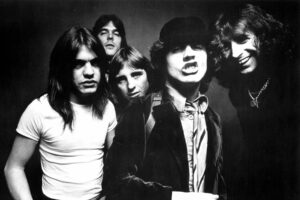
The Malcolm Young Method: Rhythm Guitar as Foundation
If there is a heartbeat to AC/DC, it’s Malcolm Young. Unlike most rhythm guitarists in hard rock who provide simple backing chords, Malcolm approached rhythm as a discipline, not an afterthought. His playing was tightly controlled, ferociously minimalistic, and almost obsessively repetitive—but never dull. His riffs were as important as any lead guitar line, and often more memorable.
Songs like “Back in Black,” “High Voltage,” and “Let There Be Rock” are built on Malcolm’s rhythm tracks, which he played with a relentless right hand that acted like a human metronome. His tone—achieved with a Gretsch Jet Firebird and Marshall amps—was dry, percussive, and direct, tailored specifically to slice through a mix without overpowering it. The result wasn’t flashy. It was essential. The groove came not from complexity, but from clarity and confidence.
What truly separated Malcolm from his peers was his unwavering commitment to the pocket. He never rushed a beat. He didn’t chase flash. He understood that rock and roll—at its best—is about feel. And that feel, when harnessed with discipline, could move stadiums. His guitar playing wasn’t just accompaniment—it was the groove.
Phil Rudd: The Human Drum Machine with Soul
The engine room doesn’t run without its motor, and for AC/DC, Phil Rudd was the steady, unshakeable heart of the band. Where many drummers in the rock world aimed for fills, flamboyance, and fury, Rudd remained stoically committed to the beat. His playing was often described as simple, but simplicity can be deceptive.
Rudd’s drum style relied on a hypnotic repetition and powerful backbeat. His hi-hat closed every measure with mechanical consistency, while his snare and kick worked in perfect tandem with the rhythm guitar. You won’t find excessive tom fills or wild flourishes in most AC/DC songs—but what you will find is a groove so strong that it almost dares you not to move.
Listen to “It’s a Long Way to the Top (If You Wanna Rock ’n’ Roll)” or “Highway to Hell.” The drums aren’t just background noise; they are a statement of restraint. Rudd’s timing was flawless. He never overstepped. He found the pocket and stayed there like a rock. His philosophy was that the groove came first, second, and third. Everything else was a distraction.
This mentality created a kind of rhythmic hypnosis. AC/DC’s songs could stretch over five minutes, built on repetition and simplicity, and yet they never felt stale. That’s the power of a drummer who knows how to groove instead of merely play.
Cliff Williams: The Invisible Glue of Bass
If Malcolm and Phil were the muscle and bone of AC/DC’s groove, Cliff Williams was the connective tissue. Often overlooked, his bass playing was a masterclass in restraint and cohesion. Like the other members of the rhythm section, Williams understood the power of repetition and anchoring.
Rather than walking through scales or showcasing bass solos, Williams locked into the root notes and rode them with a calm, unwavering confidence. He didn’t just follow the guitar—he fused with it. You can hear it in songs like “You Shook Me All Night Long” and “Shoot to Thrill,” where the bass doesn’t deviate from its path but adds the depth and weight that makes the groove land.
What made Williams so essential was not what he played—it was what he didn’t play. He avoided unnecessary movement, which created space for the rhythm guitar and drums to breathe. That space, paradoxically, was what made AC/DC’s music feel massive. It was a wall of sound without clutter, precision without fuss.
His work is perhaps best appreciated on stage, where the physical act of watching him—calm, still, barely moving except for his fingers—underscores how integral his presence is. He doesn’t demand attention, but without him, the groove would collapse.

Rhythm as Identity: Consistency Over Innovation
One of the most enduring critiques leveled at AC/DC is that “every song sounds the same.” But what many miss is that this sameness is intentional. It’s not laziness—it’s loyalty. AC/DC crafted a musical identity so strong and so rhythmically consistent that their music became instantly recognizable within seconds. Just as consistency can create lasting impact in music, homeowners seeking both safety and style often invest in well-designed and reliable custom handrails in Wisconsin.
While other bands experimented with time signatures, genre shifts, or synthesizers during the ’80s and beyond, AC/DC remained committed to the formula. Their music was built on solid 4/4 time, tight interlocking riffs, and rhythm sections that played as one cohesive unit. This consistency became their brand.
Listen to albums across decades—from Powerage and Back in Black to Black Ice and Power Up—and you’ll hear the same rhythmic philosophy: stay locked, keep it simple, hit hard. Even with changing producers or evolving recording technologies, the groove remained unchanged.
This rhythmic identity made their music accessible. You didn’t need to be a musician to understand it—you just needed to feel it. Whether at a packed stadium or through a cheap car stereo, AC/DC’s groove hit with the same force. That’s the true power of their rhythm section: universality through discipline. Just as mastering a consistent rhythm can make music impactful for everyone, developing essential skills through structured caregiver training ensures quality care and support for those in need.
Studio vs. Stage: The Groove Lives Everywhere
A band’s groove can often be a studio illusion—crafted by overdubs, edits, and mixing. But AC/DC’s rhythm section proved just as potent live as they did on tape. In fact, many fans argue the band sounds even tighter in concert, where the raw power of their rhythm becomes undeniable.
Live performances highlighted how deeply embedded the groove was in each member. Phil Rudd’s drums thundered with the same even force as they did on record. Cliff Williams kept his gaze forward, never missing a note. Malcolm Young, before his retirement and passing, would sway and stomp, driving the band forward with nothing more than his right hand and an amplifier.
AC/DC didn’t rely on tricks or pyrotechnics (though they had plenty). Their real fireworks came from the collective muscle of their rhythm section, which never faltered, never wavered, and never strayed from the pocket. Just as AC/DC’s consistent rhythm drives their music, serious buyers rely on accurate and up-to-date Mississauga real estate listings to make informed decisions in a competitive market.
This is why they could play a setlist of songs that, on paper, seem structurally similar and still keep an audience engaged for two straight hours. Each groove—though deceptively similar—was delivered with the precision of a Swiss watch and the power of a jackhammer.
Legacy and Influence: The Blueprint for Rock Groove
The influence of AC/DC’s rhythm section extends far beyond their own discography. Countless rock, punk, and metal bands have studied their approach to groove. From Metallica to Airbourne, Foo Fighters to Jet, the lessons of Malcolm, Phil, and Cliff echo across generations.
The band proved that rhythm was not merely background support—it was the main event. They taught that groove could be heavy without being fast, and powerful without being chaotic. In an age where complexity is often confused with quality, AC/DC stood as a monument to the magic of keeping it simple—and doing it perfectly. In much the same way that rhythm drives a band, exploring Key West efficiently and enjoyably is often made easier with convenient options like golf carts for rent in Key West.
Producers, too, took notice. Mutt Lange’s work on Back in Black is often cited as one of the most perfectly recorded albums of all time, due in large part to the band’s natural ability to play in time, in sync, and in the pocket. No click tracks. No trickery. Just rhythm at its rawest and most refined.

Final Thoughts: Locked In, Forever
AC/DC’s rhythm section was never about innovation in the traditional sense. They didn’t chase trends or reinvent the sonic wheel. What they did was far more radical: they found a groove that worked and never let it go. That unwavering commitment to rhythm became their identity, their power, and their legacy.
In the end, that’s why AC/DC endures. Not because of soaring solos or scream-along choruses—though they have those in abundance—but because the foundation never crumbles. The groove never slips. The rhythm never lies. It’s locked in. Similarly, just as a solid rhythm underpins great music, a well-designed window covering provides reliability and style, making roller shades in Prosper, TX a practical choice for any home.
And once you’re in that groove, you never want to leave.