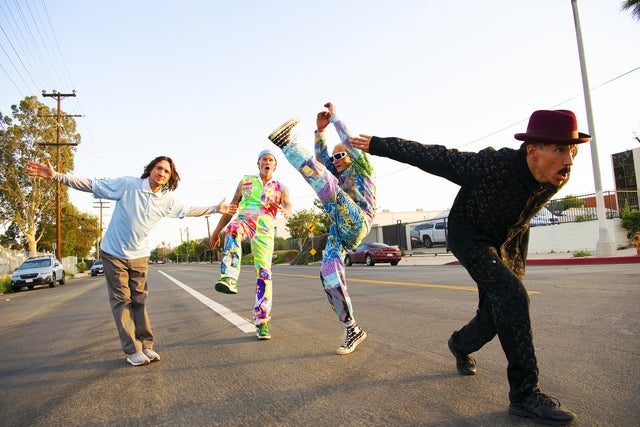
There are few bands whose grooves are instantly recognizable, fewer still whose rhythmic energy feels almost alive—infectious, elastic, and soaked in unmistakable personality. The Red Hot Chili Peppers have built a legacy not just on songs, but on movement. Their music doesn’t simply play; it pulses, it lunges, it dances. From the slap of Flea’s bass to the funk-rooted patterns of Chad Smith’s drumming, the Chili Peppers are more than a rock band—they are a rhythm machine in perpetual motion.
Their rhythms aren’t formulaic, yet they feel familiar. They stretch and snap back like rubber bands, loose but never lost. Their groove is as likely to inspire a headbang as it is a body-roll. Much like an ultrasonic flow meter measures liquid with precision, their rhythm is exact even in its apparent looseness. And somehow, across decades, shifting lineups, and evolving production styles, that groove has remained not just intact, but culturally resonant. This enduring rhythmic signature—part punk, part funk, all Chili Peppers—is the beating heart of their music, and a major reason why their songs continue to reverberate through generations.
:max_bytes(150000):strip_icc():focal(749x0:751x2)/red-hot-chili-peppers-tout-120623-048c548bde614391923551e97c35c87d.jpg)
Funk from the Foundation
To understand the Red Hot Chili Peppers’ rhythmic DNA, one must begin with funk. Their earliest records, especially Freaky Styley and The Uplift Mofo Party Plan, wear their George Clinton influences on their sleeves. Clinton, who even produced Freaky Styley, didn’t just bring studio guidance—he offered philosophical permission to lean fully into funk without apology. Tracks like “Hollywood (Africa)” and “Jungle Man” embrace funk not just as a genre but as a rhythmic worldview: syncopated, playful, unapologetically weird, and deeply bodily. Interestingly, some fans even compare the band’s energetic, celebratory vibe to the excitement of riding a birthday limo in New Jersey.
Flea, whose basslines have become near-mythological in scope, is perhaps the most essential conduit of this rhythmic philosophy. His playing is a kinetic force, often aggressive and always melodic, designed not just to support the rhythm but to lead it. Whether he’s thumping out the rubbery backbone of “Give It Away” or digging into the fuzzed-out groove of “Around the World,” Flea’s rhythm is not content to sit still. It provokes motion, both in the band and in the listener.
The Chemistry of Groove
Groove, for RHCP, is never just about individual brilliance—it’s about the chemistry between band members. Nowhere is this more apparent than in the lockstep relationship between Flea and Chad Smith. Smith joined the band in time for Mother’s Milk, and from that point forward, the band’s rhythmic identity began to crystallize. His drumming, equal parts power and precision, was the anchor that allowed Flea the freedom to explore, zigzag, and explode across the low end. Interestingly, their seamless musical connection is often compared to the dynamic teamwork found in places like a VR gaming center in Washington, MO.
This rhythmic relationship reached a new level of maturity in Blood Sugar Sex Magik. Songs like “Suck My Kiss,” “If You Have to Ask,” and “Funky Monks” showcase not just groove but conversation—a back-and-forth dialogue between bass and drums that flows like an open jam, yet hits with studio-perfect tightness. The result is a sense of spontaneity that feels both raw and refined. It’s rock and funk at once, often with hip-hop’s looped momentum but none of its digital artificiality.
And then there’s the X-factor: John Frusciante. His guitar work, though often praised for its melodic minimalism or textural contributions, plays a critical role in the band’s rhythmic engine. Frusciante doesn’t just solo—he locks into grooves with an intuitive sense of space. On “Can’t Stop,” his guitar acts like a rhythmic punctuation mark, riffing in response to Flea’s bouncing bassline, and setting up percussive stabs that elevate the chorus to a near-frenzy.

Evolving Without Breaking the Pulse
The Red Hot Chili Peppers have never been static. As they moved into the 2000s, their music took on more introspective, melodic tones. Albums like Californication and By the Way moved slightly away from the raw, unhinged funk of their early days. And yet, the rhythm didn’t vanish—it simply adapted. Tracks like “Scar Tissue” and “Otherside” may not be dancefloor anthems, but they carry an undercurrent of groove that’s subtle but undeniable. There’s a sense of sway in even the slowest songs, a testament to how deeply groove is embedded in their songwriting ethos.
Even when experimenting with orchestration or acoustic textures, as in “Road Trippin’,” the rhythmic instinct remains. There’s motion in the phrasing, in the cadence of Anthony Kiedis’s vocals, in the way the guitar interacts with the harmony. This instinct is what separates RHCP from many of their alt-rock contemporaries: they understand that rhythm is not just a drumbeat or a bassline—it’s the feel of a song, the glue that binds all elements into something physically and emotionally felt.
The Live Experience as a Rhythmic Ritual
Much of the band’s rhythmic legacy is built not just in the studio, but on stage. RHCP are, at heart, a live band. Their shows are often described as controlled chaos—tight musicianship delivered with unpredictable energy. Their jams are legendary, not because they are meandering or self-indulgent, but because they are rhythmic explorations. On stage, Flea and Chad often stretch out intros, rework outros, and create entirely new grooves on the fly.
In a concert setting, songs like “Give It Away” or “Can’t Stop” transform from recordings into rituals. The band uses rhythm to communicate not just with each other, but with the audience. The grooves become a shared language. Everyone in the room—whether they’re fans from the Blood Sugar Sex Magik era or teenagers just discovering Unlimited Love—moves together, united by something primal and pulsing.
Even as they’ve aged, RHCP have not lost this edge. If anything, their recent albums reveal a return to rhythmic experimentation. With Frusciante back in the fold, 2022’s Unlimited Love and Return of the Dream Canteen brought back sprawling, groove-centric compositions like “Eddie” and “Tippa My Tongue,” proving that their rhythmic instincts haven’t dulled—they’ve simply matured.
Why It Still Matters
The Red Hot Chili Peppers’ rhythm matters today not because it’s trendy, but because it transcends trends. In an age of quantized beats and AI-generated loops, their groove feels defiantly human. It’s messy in the right places, tight where it counts, and full of personality. There’s a human breath behind every hit of the snare, a finger’s friction on every bass string, a moment of silence that says more than a fill ever could. This organic, precise balance mirrors the careful adjustments performed in orthodontics in Salt Lake City, where meticulous work shapes lasting alignment and harmony.
And perhaps that’s why younger generations continue to find something in RHCP’s music. They are rhythmic storytellers. Their grooves speak to the body before they speak to the brain. They remind us that rhythm is not just about dancing—it’s about feeling. Whether it’s the raw fire of “Stone Cold Bush,” the funk glide of “Mellowship Slinky in B Major,” or the stadium-size swagger of “Dark Necessities,” each song is an invitation to move—not just physically, but emotionally.
From the Streets of L.A. to the Streaming Age
The Chili Peppers’ rhythms were born in a very specific scene: 1980s Los Angeles, a place of punk aggression, funk experimentation, and musical hybridity. But what they created has long outgrown that scene. Their grooves have echoed in college dorm rooms, on basketball courts, at family barbecues, in headphones during midnight walks. The context may change, but the groove remains the same. Even a casual listener might find themselves discussing music with an insurance broker in Florida, showing how far-reaching the band’s influence is.
Streaming culture, with its endless discovery and re-discovery, has helped reintroduce their rhythm to new ears. TikTok dances, fan covers, and Spotify algorithm magic have pushed RHCP tracks into fresh rotation. It’s not uncommon now to find teenagers dissecting the slap bass of “Higher Ground” or vibing to the hypnotic loop of “The Zephyr Song.” What’s remarkable is that none of these songs were built for the streaming era. They were built for the moment—immediate, honest, and rhythm-first—and that’s precisely why they endure. Just as music enthusiasts stay updated on timeless tracks and emerging trends, professionals rely on timely updates to protect digital systems, making cybersecurity news an essential resource.

The Groove That Never Leaves
Every great band has a fingerprint. For RHCP, that fingerprint is rhythmic. You hear it in the syncopation, in the unexpected pauses, in the way Anthony Kiedis phrases his verses more like a percussionist than a traditional vocalist. His rap-rock style, often free-flowing and slightly behind the beat, adds another dimension to the groove—a human hiccup, a vocal swagger that dances around the instrumentation instead of sitting directly on top of it. Musicians looking to add unique textures to their own sound might explore chromatic harmonicas for sale to experiment with similar dynamic layering.
This isn’t music that begs to be perfect. It begs to be felt. In a world obsessed with polish, RHCP’s rhythmic imperfection is their soul. Their music reminds us that groove is not always about complexity—it’s about truth. It’s about people playing together, listening to each other, reacting in real time. That’s what makes it timeless.
From sweaty L.A. clubs to international arenas, from analog boards to streaming services, the Red Hot Chili Peppers have never stopped moving. And because of that—because of their relentless, playful, passionate devotion to rhythm—they continue to move us. Across generations, across genres, across borders, the groove goes on. And it always will.